Given the high number of the world’s data centres located in the U.S., many countries including Canada are attempting to attract their own facilities over concerns about data sovereignty risks.
The Canadian federal government recently encouraged investment in new or expanded hyper-scale facilities by issuing a call for new project proposals. It also allocated $700 million of the $2 billion Canadian Sovereign AI Compute Strategy to specifically mobilize private sector investment in new or expanded data centres.
For the construction industry, data centres appear as a bright spot at a time when activity is showing a slowdown across other forms of non-residential sectors. However, multibillion-dollar project cost announcements can be misleading.
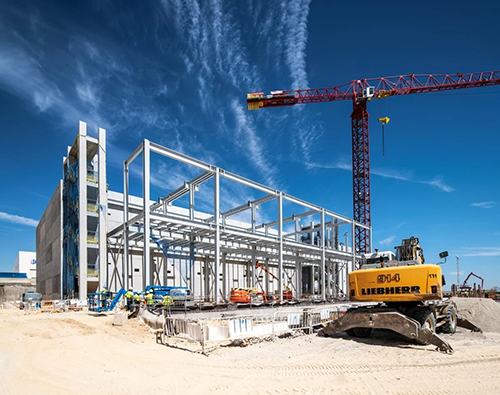
McKinsey says only 15 per cent of data centre investment flows to builders for land, materials and site development. The remainder is for power generation and transmission, cooling, electrical equipment and for the chips and computing hardware itself.
In fact, direct construction jobs are relatively short term, between 12 to 36 months.
As Ellen Thomas of the CBC said recently, many of the construction and mechanical workers are “professionals going from site to site.”
Most facilities are either fully or partially prefabricated, reducing the required local construction work force.
At the same time, communities are becoming wary about the arrival of data centres in their area. Topping their list of concerns are possible electricity cost increases for local residents and businesses, the cost of infrastructure investments to support new power generation and distribution, and the high volume of local water data centres might require for cooling.
Developers are being forced to address these and other topics more openly in their proposals.
For example, what measures are being taken to address pollution and CO2 emissions, damage to wildlife and excessive noise? What levels of long-term employment can be expected? What are the benefits for the community?
The number of permanent new jobs associated with data centres can also disappoint.
“Data centre developers often over-promise or adjust job estimates in order to placate local opposition, so job estimates should be taken with a large grain of salt,” says the Canadian Centre for Policy Alternatives (CCPA) .
Once operational, the number of full-time employees is surprisingly low. A 153,000 square foot data centre developed by Cigna Corp. in Connecticut created only five new jobs.
Larger data centres aren’t much better. According to one study, a one-million-square-foot hyper-scale data centre employs between 25 and 150 personnel. A commercial office complex of the same size might hold between 4,000 and 6,500 workers, and a low-labour density facility like a shopping centre between 1,500 and 3,000.

Local communities expecting a tax revenue bonanza from new data centres might also be disappointed.
“Certainly data centres can provide significant tax revenues as long as governments do not sacrifice those taxes in a bid to attract the data centre in the first place,” explains the CCPA.
However, some levels of government in the U.S. and Canada have offered generous tax incentives to data centre developers.
“Providing tax exemptions to a facility that may very well increase the cost of living for its surrounding residents would seem to be a poor use of public policy.”
In the United States, resistance to data centres is becoming a serious matter.
In April, Maine became the first state in the country to pass a bill placing a moratorium on new data centres, reports Reuters.
The bill also freezes until October 2027 the approval of data centres requiring more than 20 megawatts of power, to allow a state-appointed council to analyze their impact on the local grid, electricity bills, air and water.
Many local governments are doing the same.
The city council of Madison, Wis., unanimously passed a one-year moratorium on telecommunication facilities of over 10,000 square feet within city limits to give city staff time to study data centres and develop permitting procedures for facilities that store, manage, process and warehouse data.
The city of Lowell, Mass. and Griffin County, Ga. are among several others that have passed similar moratoria.
These added complexities and local issues have negatively impacted data centre development, says a February CBRE report.
“The total amount of new capacity under construction in primary markets declined for the first time since 2020. There were 5,994.4 MW under construction at the end of 2025, down from 6,350.1 MW in 2024. Many planned projects remain delayed due to ongoing permitting, zoning and power procurement hurdles, underscoring the complexities of scaling infrastructure.”
As one of the most active developers of data centres around the world, Microsoft has recognized the ground swell of opposition that is growing.
“Communities value new jobs and property tax revenue, but not if they come with higher power bills or tighter water supplies,” the company said in a January blog post. “Without addressing these issues directly, even supportive communities will question the role of data centers in their backyard.”
Microsoft has issued what it calls a Community-First AI Infrastructure Plan that “commits us to the concrete steps needed to be a good neighbor in the communities where we build, own and operate our data centres.”
This involves paying electrical utility rates that are high enough to cover the cost of the power used by new data centres, minimise water use and replenish the water that data centres use, as well as partnering with the community on job training, while growing jobs and the tax base.
With only 16 per cent of Canadians expressing outright support for data centre projects in their area, Canadian developers must recognize that future success is not about fence-mending after the fact; it’s about building alliances at the very beginning.
John Bleasby is a freelance writer. Send comments and Inside Innovation column ideas to [email protected].