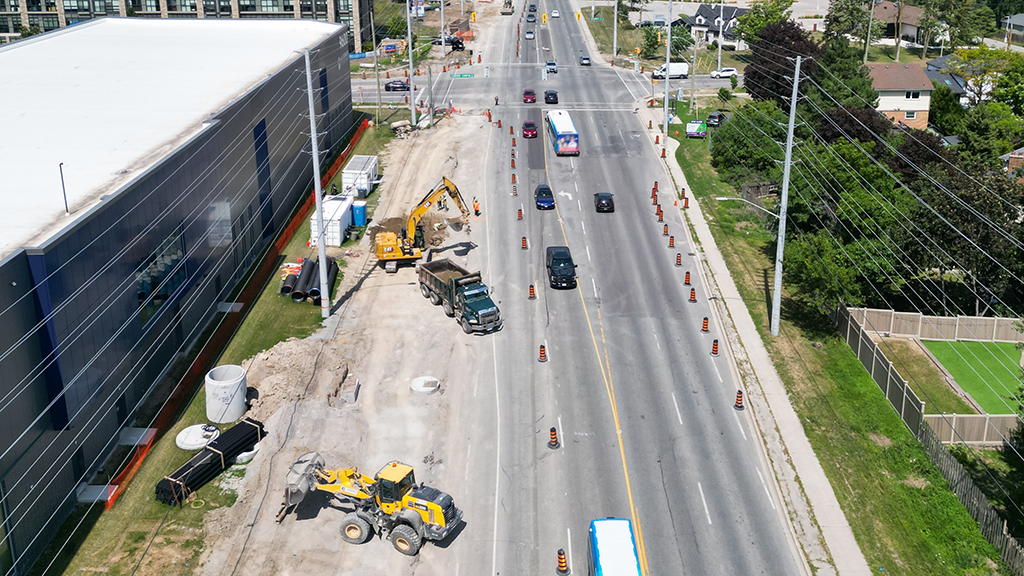
After being put on hold for more than a decade so as not to conflict with another project, a $127-million, four-kilometre long widening of Bathurst Street from just north of Highway 7 to Major Mackenzie Drive in York Region got underway this spring and will take until 2028 complete.
The Parsons Corporation is the design consultant and Fermar Paving is the general contractor in charge of the project which consists of a whole catalogue of works.
Besides expanding the four-lane roadway to six lanes, the contractor will install more than two kilometres of a 300-millimetre-diameter watermain and two 10-metre-wide, four-metre-high box culverts with lengths of up to 52 metres.
One set of existing twin culverts will also be rehabilitated and extended to accommodate the roadway widening and two overflow culverts will also be installed using micro tunnelling methods, says York Region’s capital delivery director Salim Alibhai.
Other planned work will include the installation of a landscaped median, a continuous sidewalk on both sides of the road, bicycle lanes and the creation of two new parkettes.
The project will support population and community growth, help reduce travel delays, support active transportation and safer pedestrian crossings, and improve reliability for transit and emergency services, says Alibhai.
As an example, he cites the expanded highway’s high occupancy/transit lanes. They will extend from Major Mackenzie Drive to the Highway 7 ramp to connect with York Region’s Bus Rapid Transit (BRT) network.
Bathurst Street is the boundary between the cities of Richmond Hill and Vaughan and on an average daily basis 60,000 vehicles travel that section of the street, says Alibhai, in underscoring the need for the expansion.
“Delivering a major road project can take eight to 10 years to complete,” says Alibhai, noting the origins of this one go back more than 15 years.
Its need was first identified in York Region’s master transportation plan in 2009. Design work by Parsons started in 2011 and construction was originally scheduled to begin in 2014.
But construction of the Yonge Street BRT line was also scheduled to begin that year and the region made the decision to delay the Bathurst project until the BRT was completed.
Bathurst and Yonge streets are parallel streets in close proximity and the rationale was to minimize the impact on commuters and the neighbouring communities, he explains.
As for measures to lessen this project’s impact on adjacent homes and businesses, they include maintaining access to homes and businesses and keeping four lanes of traffic during peak travel periods.
“Night work may be undertaken for certain tasks, such as paving, to minimize the impact to travellers and expedite the project.”
Residents and businesses are kept informed of the project’s progress through a mix of road signs, construction notices, social media posts and advertising.
Notices were distributed to homes and businesses, including a notice of construction last fall and project commencement postcard this spring, he says.
Asked about some of the project challenges, Alibhai says the contractor will have to deal with high groundwater conditions at certain locations. Portions of the project are located in river valleys or creek sites where the groundwater levels can be relatively high and encountered at shallower depths during excavation.
As for the specifics of the project’s pacing, approximately six to eight construction crews ranging from 35 to 50 workers at a time can be expected to work onsite during the peak construction period between July and September each year of the project, he says.