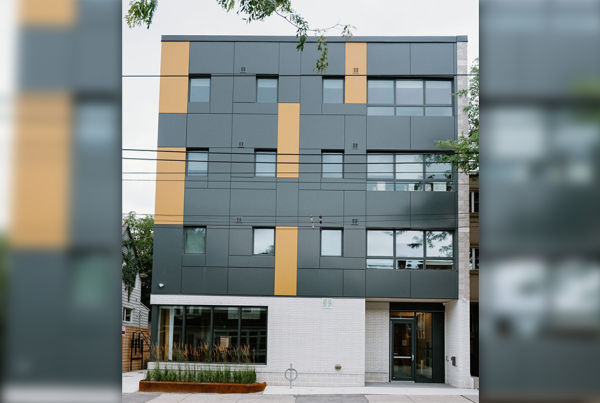
A two‑building, 475,000‑square‑foot mixed‑use development on the edge of Coney Island’s amusement park district is drawing attention for its energy strategy, anchored by what is touted as the largest geothermal heating and cooling system in New York City.
“This is a flagship project that moves geothermal from theory to proof in dense urban multi-family and mixed-use environments,” says Arjun Mehta, vice-president of Ecosave, which provided the geo-thermal system for developer LCOR.
The project includes 463 rental apartments (139 of which are affordable), 11,000 square feet of retail and a 76,000-square-foot garage. The high density site has buildings on three sides and the busy amusement park across the street.

The project was completed about 18 months ago and is currently operating at “close to optimum conditions,” using about 60 per cent less energy than conventional heating/cooling systems, according to Mehta.
For LCOR, it illustrates the ground-source system can meet its electrification and decarbonization goals and be on track to meet long-term life cycle costs, he says.
“The developer is investing in this technology knowing exactly what the returns would look like, five, 10 and 15 years and beyond.”
Key to the project’s success was early design co-ordination with the developer, tightly managed sequencing among the trades responsible for the 500‑foot‑deep installation and a package of financial incentives.
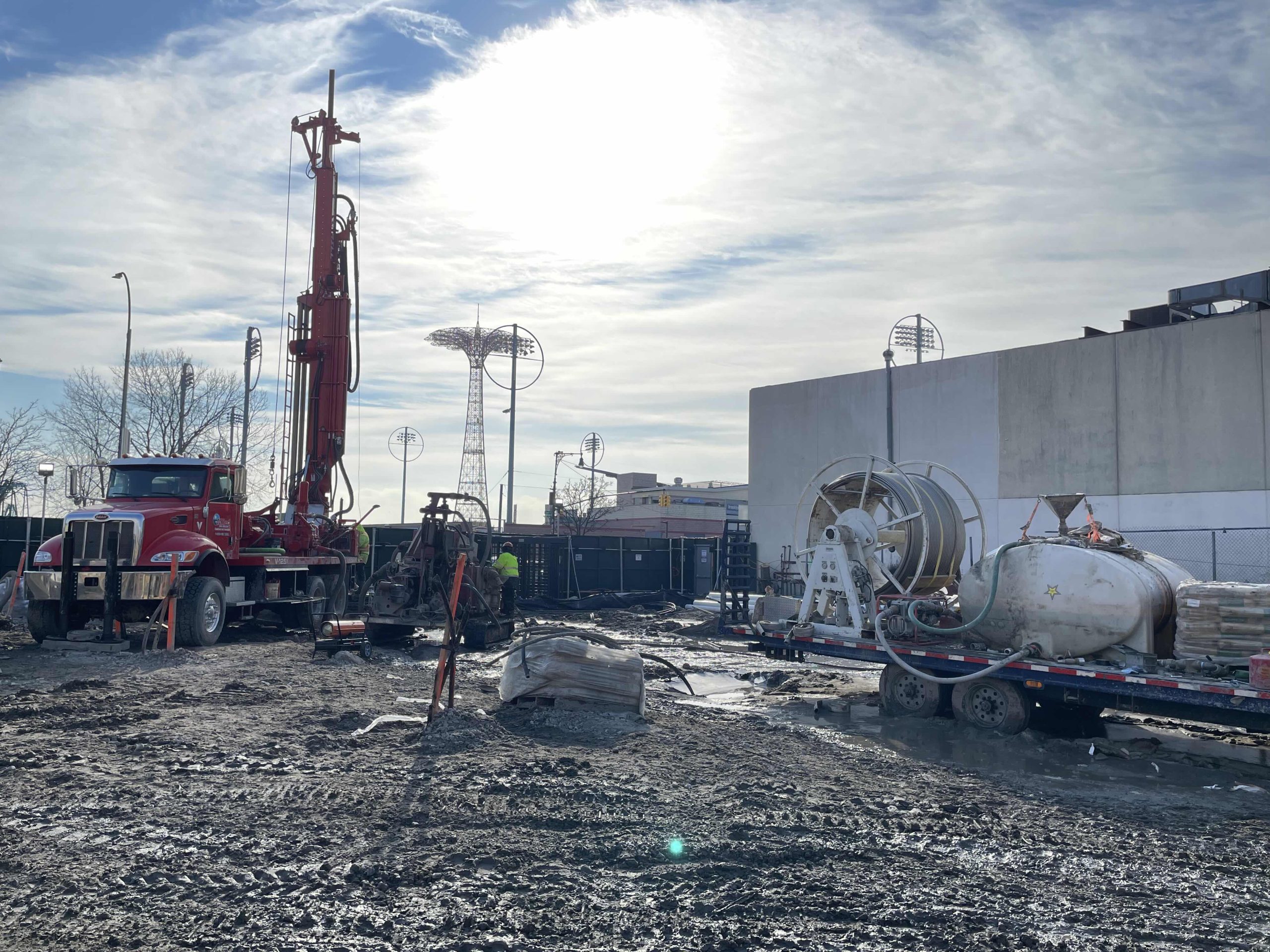
The first step was drilling 153 boreholes for the geothermal field. Concrete piles and pile caps were placed and once the concrete subfloor was in the mechanical room manifold piping was installed, says Mehta. It took about seven months to complete the ground source network.
Developers typically dismiss geothermal for its upfront costs and lost time on installation but a true comparison with a conventional system includes the incremental savings on the operation and maintenance of geothermal, he points out.
While a simple payback is 13 to 15 years compared to conventional heating/cooling, Mehta says the project’s amortization will be achieved at five years because of the financial help received through government incentives, including $1.7 million from the New York State Energy Research and Development Authority and $2.9 million from Con Edison.
To “accurately estimate” the performance of the system, Ecosave first conducted a soil condition feasibility study, boring to 500 feet (the maximum depth permitted at the time) to identify hard and soft bedrock conditions plus silt levels near the water table at the deepest levels.
The geothermal network includes a heat exchanger 500 feet below grade. The energy costs – pumping water through the system – are “significantly lower” than conventional systems and because geothermal doesn’t have a lot of mechanical equipment, maintenance is low, says Mehta.
“You are not spending any more than what you would have spent on a pump that moves around chilled and boiled water.”
Mehta says many developers don’t consider geothermal because they don’t understand it.
But not every site is suited to the ground-source energy system. Soil conditions are a factor and while technology exists for geothermal under existing projects through drilling at angles from vacant adjacent to the project, it is often “a very challenging and costly option,” he says.
Securing permits can be challenging as well, largely because many regulatory authorities have been unfamiliar with the technology.
But that is changing and regulatory agencies in New York and New Jersey are seeing its merits and allowing geothermal fields up to 800 feet deep
The additional 300 feet creates opportunities for more thermal energy exchange and storage on smaller properties, Mehta says.
“I expect New York to move into geothermal, even though slowly. The real challenge is (finding) a vacant piece of land for development which is more suitable and cost effective than working with existing buildings.”