World events in the Middle East have coincided with a U.K. government initiative to reduce the country’s dependence on fossil fuels. As recent government policy recommendations come into effect, the U.K. will soon be saying “bye-bye” to gas-fuelled residential boilers and “hello” to heat pumps and plug-in solar panels.
The United Kingdom is far more sensitive to global energy crises than Canada. Shortly after Russia’s full-scale invasion of Ukraine in 2022, whole sale gas prices increased more than four-fold before settling back to previous levels. Since the United States began bombing Iran a few weeks ago, the price of natural gas in the U.K. has spiked by as much as 70 per cent.
As reported by Reuters, although only around one per cent of Britain’s gas supply comes from Qatar, Britain is far more dependent on natural gas for power generation than other countries — approximately 30 per cent versus 17 per cent in Germany and three per cent for France. Natural gas also heats more than 70 per cent of British homes.
These significant events beyond their own borders have resulted in a response from U.K. policy-makers. The first step could happen very shortly.
“’Plug-in’ solar panels are to be in shops within months, offering households the chance to significantly cut energy bills,” says a government media release. “More households will be helped to save money on bills through plug-in solar panels as the government vows to go further and faster on clean energy in response to conflicts in the Middle East.”
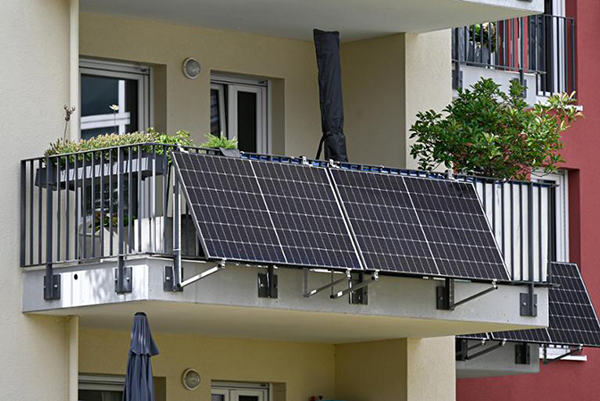
It is expected these panels will be placed on balconies or other outdoor spaces.
More significantly, beginning in March 2027, the Future Homes and Buildings Standard will come into force with a 12-month transition. New homes will be required to not only have PV arrays representing 40 per cent of the dwelling’s ground floor area but must also be equipped with electric heat pumps.
“As we make the switch to clean, homegrown energy, today’s standard is what the future of housing can and should look like,” said Housing Secretary Steve Reed. “Not only will these changes protect hardworking families from shocks abroad but will also slash hundreds of pounds off their energy bills every year.”
The Future Homes and Buildings Standard is partly an attempt to correct a past error. Back in 2015, the U.K.’s Zero Carbon Homes Standard was cancelled, leaving British families exposed to the energy price spike shortly after Russia’s invasion of Crimea.
The present government does not wish this to be repeated. New regulations have been brought before parliament to quickly introduce the new standard.
Although Canada is somewhat shielded from the level of gas price volatility experienced in the U.K., one might wonder how a similar move towards individual solar installations and heat pumps would be received in this country. Not surprisingly, the response from some quarters in the U.K. is not much different than what might be anticipated in Canada.
The Home Builders Federation (HBF) has told the government the 40 per cent provision of photovoltaics to floor area required for new dwellings, “is very high as a percentage of equivalent floor area.”
It believes the measures are “too prescriptive and will limit innovation in the development of other ways of making new homes more energy efficient.”
It would likely lead to “significant unintended consequences,” including “a negative impact on house design.”
The policy does in fact allow some exceptions. The HBF also expresses several reservations concerning mandatory heat pump installation.

The HBF said “the new homebuilding industry is committed to help the government deliver an 80 per cent reduction in CO2 emissions by 2025 and beyond with zero carbon ready homes.”
However, it feels the Future Homes and Buildings Standard introduces too much too fast. It points out the standard won’t help the millions of Britons who don’t live in a new-build home. It also warns the required “stability and known costs in order (for the building industry) to operate successfully” will be disrupted by the standard’s sudden imposition.
The HBF also notes other previously imposed regulatory changes had already added £20,000 (CDN$37,000) to the cost of a new home. These latest changes would add even more, as much as an estimated £10,000 (CDN$18,000) according to the BBC.
Here in Canada, there are several government programs available that support the transition to heat pumps. For example, the federal government offers an upfront payment of up to $10,000 to switch from oil heating to new, energy-efficient heat pumps for Canadian homeowners with household incomes at or below the median household after-tax income.
Although a default option in most regions of Canada, to date only the City of Vancouver heavily favours or requires electric heat pumps for space heating in new, low-density residential buildings or certain renovations.
And as for plug-in solar panels, some Canadian municipalities and their residents might not take kindly to solar arrays adorning balconies and yards.
Nevertheless, the U.K.’s initiative could be regarded as a “shot over the bow” for Canada to look closely at energy and space heating alternatives in a world of disruptive and unpredictable events.
John Bleasby is a freelance writer. Send comments and Climate and Construction column ideas to [email protected].