The American side of what is now Canada and the United States’ busiest bridge for international trade is in the middle of a major revamp, aimed mainly at realigning local community access and traffic patterns as well as reconfiguring operating facilities.
Windsor-Detroit’s Ambassador Bridge had long been North America’s busiest trade crossing but the Blue Water Bridge between Port Huron, Mich. and Sarnia, Ont. surpassed it last year with 2.1 commercial crossings compared to the Ambassador’s 1.9 million. The major cause was truckers diverting from the Ambassador because of significantly higher tolls, $27 per axel compared to $7.
The work is a multi-decade effort to overhaul the American port of entry and ancillary access, some of which, like a freeway interchange and a welcome center, was completed a decade ago.
Money has held up what is now the current work on the bridge plaza itself. The state has completed the first phase, begun a year ago, and is moving to the second this summer. There are future phases, but they are contingent on federal funding.
The six-lane bridge is actually two structures, one built almost a century ago and the other in the 1990s. But the U.S. port of entry is about 1,000 feet inland from the St. Clair River with connections directly on to Interstates 94 and 96. And that’s where some of the longtime traffic and access issues needed correction.
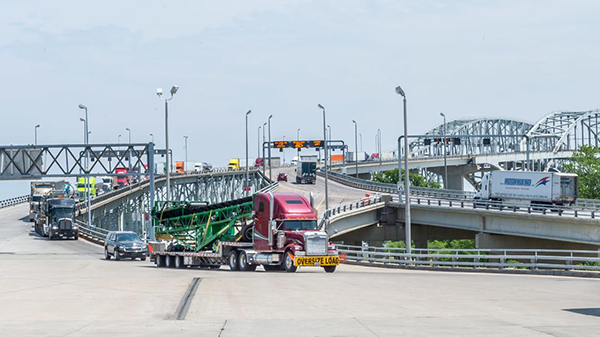
The first phase entailed relocating Exit 275 from eastbound I-94, reconfiguring a critical local city intersection and adding noise walls and landscaping.
The second phase will see the toll plaza expanded to the south.
The critical issue is a bizarre off ramp from the freeway to a duty-free store off Pine Grove Avenue.
After completing a duty-free purchase Canada-bound motorists must re-enter the bridge from a restricted street.
“That’s of course because when you go to a duty-free store you can’t re-enter the United States,” project manager Carrie Warren said.
But that “unusual arrangement” also allowed trucks to divert around freeway backups “and shortcut through the duty-free parking lot to try to cut the line,” she said.
Now that store will be brought inside the plaza footprint.
Another major change “for safety reasons” is constructing a building for secondary inspection behind the U.S. customs primary booths.
“Currently they don’t have a facility for that, and they just stand on the plaza and wave people over and it’s very unsafe,” Warren said.
There will also be a new administration building for the Michigan Department of Transportation (MDOT) and adjacent equipment storage building.
“That’s for our large speciality equipment that we use to maintain the complex long span bridges,” she said.
Then there’s a U.S. customs “non-intrusive inspection” building.
“That’s sort of a big pole barn that semi-trucks can drive through in order to be inspected” by X-ray.
To round things off there are five bridges or ramps that are being constructed.
“Our existing plaza is elevated about 30 feet in the air, so we need those connections in order to have our expansion to the south side climb up to the existing elevation of the plaza in order to access the approaches and get to the bridge.”
Challenges?
“Yes, of course, because otherwise civil engineering would be very boring,” Warren said. “But generally, we have a really great team, some of whom have experienced the project dating back 25 years and a lot of the things we’ve encountered have been expected.”
In fact, the plaza footprint has been shrunk “in order to avoid impact to the surrounding residential areas and finding a way to operate both the tolling operation and the national security scenario in a more compressed area.”
She said the project’s goal was not “capacity improvement” to expedite more traffic across the border but to separate local and international traffic which caused congestion by, for example, the duty free, updated safety and technology. Phase two should be completed by 2030.
During the whole process cross border traffic interruptions have been minimized.
“That’s going to make it take a little bit longer,” she said.
The final two phases are up in the air. The third would be an expansion north for secondary commercial inspection. The fourth would be refurbishment of the existing plaza itself for more inspection lanes and a new admin building.
But, Warren said, these phases remain open ended until the feds commit to the projects.
“We’re waiting on their ability to commit to furnish lease and occupy if we do construct it.”