In an almost back-to-back operation, the City of London is significantly enhancing flood protection for two wastewater treatment plants.
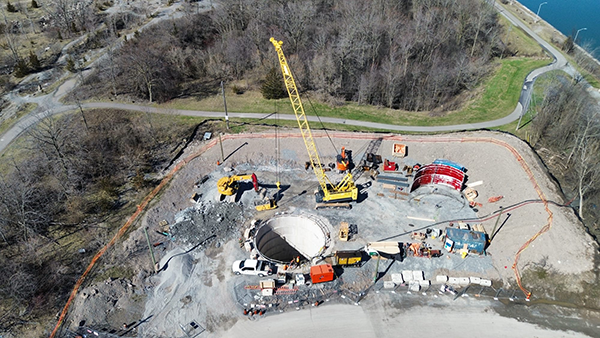
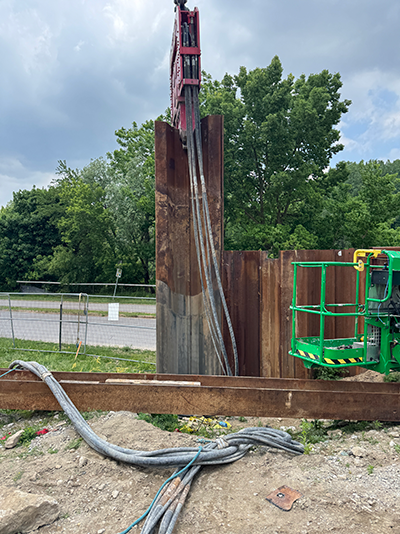
A combined 450-metre-long sheet pile wall and earthen berm has been built around the Greenway Wastewater Treatment Plant, with a second berm installed at the Adelaide Wastewater Treatment Plant. They are intended to provide protection from one-in-250-year floods.
The height of the berms vary, with the highest being about three metres above grade. Some areas only required adding about 100 metres of earth to the existing grade, says the city’s division manager for wastewater treatment operations Kirby Oudekerk.
Approximately 10,000 cubic metres of imported clay material and 2,500 cubic metres of reused stockpiled stripped topsoil were used in the construction of the Greenway berm. Building the term at Adelaide required 14,000 cubic metres of imported clay material and the reuse of 2,000 cubic metres of topsoil which had been stripped and stockpiled.
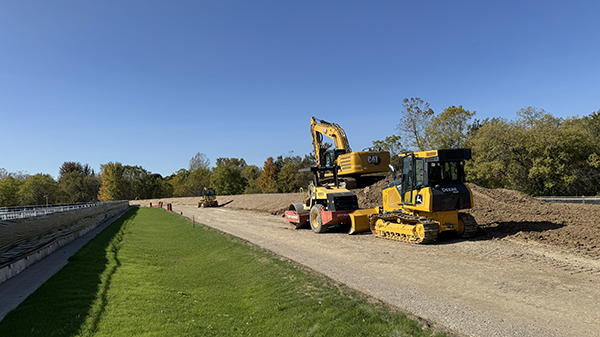
The $25 million project at Greenway, which began in 2024 and wraps up this September, also includes the installation of an effluent pumping station to allow for full treatment during flood events.
An effluent pumping station has also been installed at Adelaide, along with a flow equalization tank for enhanced wet weather management. Valued at $23 million, this project also started in 2024 and is expected to be completed at the end of 2027.
CIMA+ is the design consultant and contract administrator for both projects. Montrose Environmental (now Onterris) is the civil consultant. Stone Town Construction is the general contractor for both plants as well as building the berm at Greenway. However, it subcontracted the berm work at Adelaide to Bre-Ex Construction.
The project also included building up the access roads to maintain vehicle access to the plants, says Oudekerk.
There was no one particular event that sparked the projects. But there was a flood in 2018 that put the west access road at Greenway underwater, he says.
Recent revisions to the Thames River flood elevations data also reinforced the need for the projects.
Both plants are set in low lying areas immediately adjacent the Thames River. Greenway is on the main branch and Adelaide is the north branch.
In pointing out the risks involved, the division manager explains wastewater plants rely on gravity to collect sewage which is why they’re usually located in low lying areas. Since the plants discharge into the Thames, they are exposed to flooding risk.
Over $1 billion in infrastructure could be impacted by a flood without some form of protection, he points out.
Flood protection at the city’s Vauxhall plants was completed in 2020, while two other plants are higher in elevation and less exposed to risk.
“Where possible, earth berms represent the lowest cost option, and they are typically able to be vegetated which reduces the visual impact,” says Oudekerk, when asked about the decision to use them.
However, they can consume a considerable amount of space — which isn’t always available in sections — which is why the sheet pile wall had to be installed in some areas at Greenway, he says.
There can be considerable challenges in building berms in low lying areas right beside rivers. Soils next to rivers can be softer than preferred and sometimes dewatering is required. But that wasn’t a major issue at either plant, says Oudekerk.
Building the berms did have impacts to the adjacent communities and, at the Greenway site, almost 100 trees had to be removed to complete the flood protection measures. They will be replaced as part of the city’s tree replacement program.
When asked about the hurdles of conducting two similar projects that are only five kilometres apart within a very tight frame, Oudekerk acknowledges there were challenges, but also benefits.
“There were efficiencies realized since the city was able to conduct public consultation sessions and undertake preliminary work at the same time. As the two projects are similar, using the same design consultant also helped ensure consistency.”
Efficiency was also achieved by pre-qualifying the same group of contractors on both projects, he says.
“Internally, there are strains on staff resources in managing two very large projects at the same time while also continuing with other projects, but the majority of flood protection work has been staggered in time between the two plants.”
The city was able to obtain 40 per cent federal government funding for both projects under the government’s Disaster Mitigation and Adaptation Fund, he says.