The downtown core of Dallas has suffered through prolonged stagnation in commercial office vacancy.
Towers built during the boom times 40 years ago are now reportedly half-empty. Overall vacancy sits at close to 30 per cent.
“Most of those buildings are owned by lenders,” Ray Washburne, vice-chairman of the Gillon Property Group told D Magazine. “They’re basically zombie buildings.”
One reason companies have left the downtown core in droves is the lack of parking. Despite efforts to improve and expand public transit and make the downtown core walkable, workers prefer to drive to jobs located closer to their suburban homes. Another problem is the perceived lack of safety, despite the expansion of Dallas’ downtown police force.
There has been serious discussion about making the downtown core more pedestrian-friendly and attractive to family residency and local shopping.
The downtown population has increased in recent years to around 15,000 and 20 acres of public parks have been added, but there is still a long way to go. Standing in the way is the type of office buildings built in the 1980s. Many aren’t convertible to other uses for structural reasons or are judged uneconomical for conversion.
At the same time, overall indicators point to Dallas commercial activity being alive and well, despite the lack of new projects in its core.
Statistically, Dallas-Fort Worth marked the second-highest population growth in the United States in 2025 and has enjoyed the number one ranking nationally for corporate headquarter relocations from 2020 to 2025. The city has also earned the top spot in a recent ConsumerAffairs national ranking of new-home activity.
“The Dallas office market started 2026 on a positive note as momentum from 2025’s strong close carried into the first quarter,” says Jones Lang LaSalle in its latest quarterly research report. “Move-ins from several large occupiers helped occupancy gain over 300,000 square feet of positive net absorption, and leasing activity stayed in line with recent quarterly averages even as macroeconomic changes sent new challenges into the market.”
Although the downtown core has its occupancy challenges, there are several exciting new developments in areas just beyond.
For example, the 850,000-square-foot Urban Towers, with its four imposing glass towers, is a LEED Gold certified campus 12 miles north of downtown. Also north of downtown is Pinnacle Tower, a 24-storey, 550,000-square-foot commercial building that has recently undergone a $9 million interior renovation. Like the Urban Towers, the Pinnacle Tower is over 85 per cent leased.
What may continue to drive more businesses to the Dallas-Fort Worth area is the new Texas Stock Exchange (TXSE), a fully integrated, electronic, national securities exchange scheduled to begin trading next month.
The TXSE will be headquartered in the new Bank of America Tower at Parkside, a 30-floor LEED Gold-certified building designed by architects Kohn Pedersen Fox, expected to be completed in 2027. It will also serve as the regional headquarters for the Bank of America, which will occupy half of the available 500,000 square feet of leasable space.
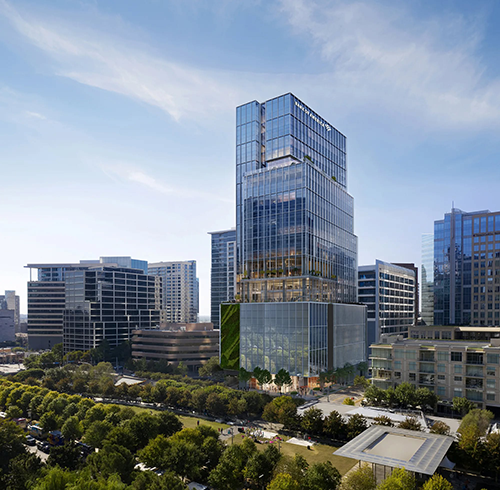
The project’s website describes the Bank of America Tower as being “located in the epicenter of Dallas’ most pedestrian rich neighborhood and is the epitome of convenience for well-heeled employees and adventurous out-of-town visitors.”
The building will be immediately adjacent to the five-acre Klyde Warren Park, described as “an urban oasis.”
However, given the attraction of corporate campuses located in outlying areas, it begs the question as to what should become of the city’s older commercial towers in the downtown core.
American real estate developer and board chair at the U.S. Chamber of Commerce, Ross Perot Jr., suggests a clear boundary should be drawn around a targeted redevelopment zone of perhaps six or seven blocks. Incentives should then be offered to developers willing to invest within those boundaries, thereby pushing owners to either renovate outdated towers or replace them with something new.
The future of the Dallas City Hall and its surrounding 4.7 acre plaza remains very much up in the air, but could be a catalyst for a revitalized downtown, as could be the $3.5 billion redevelopment of the Kay Hutchison Convention CenterKay Bailey Hutchison Convention Center Dallas – Master Plan Component 3StatusAwardValue$300MLocation650 S Griffin St, Dallas TXSectorPublic – CityTypeConference / Convention Centers · Addition, Demolition, RenovationData as of June 15, 2026View Project Page → expected to be completed in late 2029.
However, caution is in the air.
Economist Cullum Clark with the George W. Bush Institute-SMU Economic Growth Initiative is concerned the convention center could be isolated from the rest of downtown and surrounded by empty streets. Conventions only fill the space part of the time, he says.
“If there isn’t something bringing Dallas residents into that area the rest of the time,” Clark says, “the space will be empty and unpleasant.”