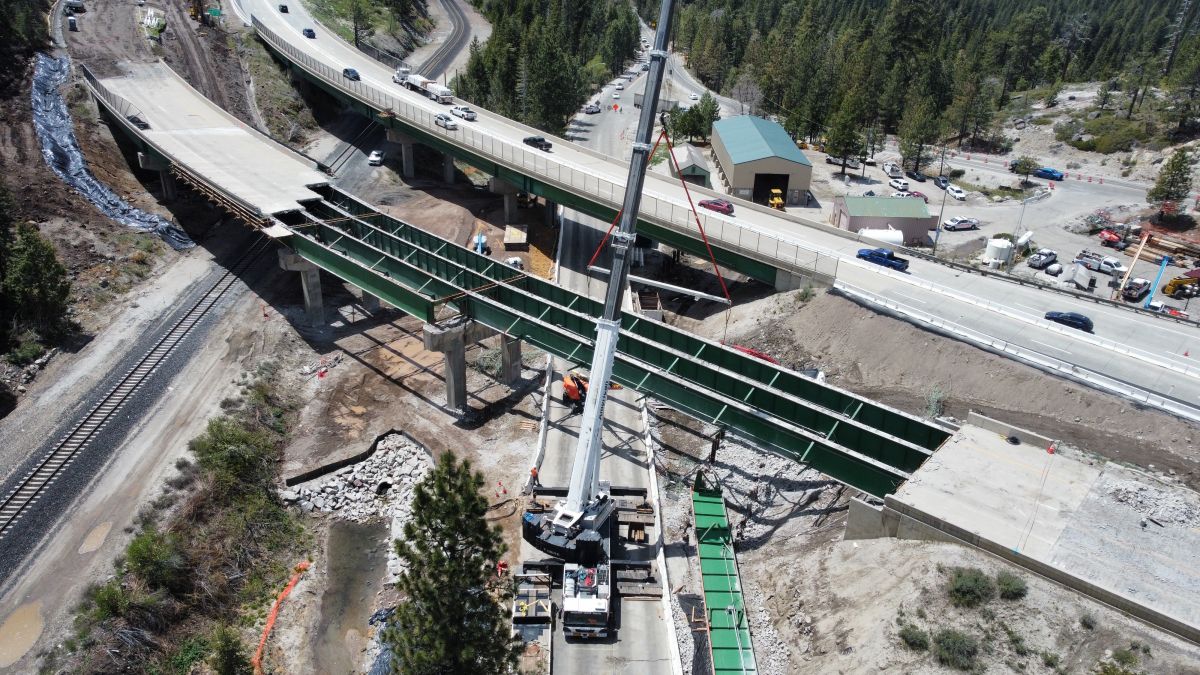
The California Department of Transportation (Caltrans) is in the process of replacing two bridges on Interstate 80 near Whitmore, from west of Crystal Lake Road to east of the State Route 20 Separation at Yuba Pass SOH Bridge.
The $112 million project was launched because, according to Caltran’s Structures Maintenance and Investigations, the existing bridges have a poor health rating and do not meet load-carrying capacity for freight movement freight trucks.
Both bridges are more than 50 years old, built in the early 1960s, and now feature severe transverse and longitudinal cracks in the concrete decks, spalling concrete and high corrosive chloride content in the concrete deck surfaces and bridge superstructures and substructures. These defects limit the bridges’ load capacity.
“Additionally,” Jeremy Linder, public information officer for Caltrans District 3, told Construction Equipment Guide, “numerous corrugated metal pipe culverts within the project area are severely rusted and need replacement.”
Replacement Goals
The Yuba Pass Separation Overhead Bridge Project at approximately 5,200 ft. elevation will replace, widen and lengthen the two bridges to provide freight load-carrying capacity for extra-legal load trucks.
Crews will add retaining walls in the median, replace severely rusted culverts in the project area and rehabilitate drainage systems that have reached the end of their service life. Additionally, they will install roadway weather sensors and traffic management systems from west of Crystal Lake Road to east of State Route 20.
With prime contractor Flatiron Construction of Concord, Calif., overseeing approximately 25 employees working two shifts, the project that began in 2024 is on track for scheduled completion in December 2027, despite work stoppages whenever crews are within 25 ft. of active railroad tracks.
Crews must pause all activity near the tracks for each passing train — as often as 20 times a day. To accommodate active Union Pacific Railroad operations, Linder said “a 24-hour operation was implemented with multiple crews across each shift to maintain productivity.”
Additional challenges stem from a limited work window, May 1 through Oct. 15, due to weather conditions. Increased manpower and continuous operations help to stay within the allowable timeframe.
“Work outside this window is allowed, however not guaranteed, depending on the weather forecast,” Linder said.
Extended lane restrictions and closures to accommodate crossover construction as traffic shifts to one lane and intermittent nightly traffic holds to install precast concrete girders for the new eastbound bridge have periodically caused significant traffic delays on the mountain pass and temporarily closed on- and off-ramps but are intended to minimize the duration of the work and improve workers’ safety.
Milestone
Stage two of the project in the majestic Sierra in Northern California began in June 2025 and included a two-week extended closure and traffic switch that moved two eastbound lanes to the westbound side using crossovers built in stage one the previous year. Crews closed about 2 mi. of eastbound I-80, demolished the existing bridge and started building a new one, including a new approach roadway.
Work under stage two included foundation shoring, falsework erection and precast girder placement over the tracks. Crews must demolish the existing bridge before building a new one, including a new approach roadway. To avoid delays from early snowstorms, the bridge was open to traffic by mid-October.
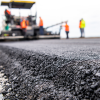
To complete the project, multiple extra-large cranes, excavators, loaders, transfers, concrete placing equipment and asphalt pavers and transfers are put to good use.
“The project required extra-large cranes due for demolition and removal of large existing steel girders and installation of a precast concrete structure spanning the active railroad,” Linder said.
An onsite concrete crushing plant saves time, with crushed concrete and roadway excavation material being reused onsite. Linder says that existing steel girders and reinforcing steel are hauled off site for recycling.
Funding
This project is programmed in the 2022 State Highway Operation and Protection Program and funded through the 20.XX.201.110 Bridge Rehabilitation and Replacement Program.
The project includes $13.4 million from Senate Bill 1, the Road Repair and Accountability Act of 2017. SB 1 provides $5 billion in transportation funding annually that is shared equally between state and local agencies.
Road projects progress through construction phases more quickly based on the availability of SB 1 funds, including projects that are partially funded by SB 1. ♣