The recycling and reuse of components from demolished buildings, such as windows, doors and certain structural elements has become increasingly popular.
These can be put to good use in new projects. Concrete walls, floors, beams and posts are usually reprocessed into base materials. Once crushed into recycled concrete aggregate, it serves as a highly stable, cost-effective alternative to virgin gravel or stone when sold back to the construction industry.
In Europe, experimentation and studies have been carried out in recent years that offer another future for large precast or poured concrete building components. Instead of grinding them up, the concrete pieces can be cut and given new purpose in another project.
One approach to this was undertaken in the Île-de-France region in northern France. HABITAT 77, a provider of diverse social housing options, has taken concrete slab walls from a former parking garage and reused them for 470 m2 (5,059 square feet) of paving at one of its nearby projects.
Reusing the concrete was a two-step process. First, the slabs were cut from the parking structure. Next, the cut pieces were assembled like flagstone to cover the desired surface area. Each slab was cut into squares weighing about 300 kilograms with thicknesses between 15 and 20 centimetres.
“They couldn’t be too small, otherwise the cutting cost would be too high, nor too large, so that handling would remain easy,” explained project co-ordinator Hugo Topalov.
Avoiding crushing has environmental benefits. It reduces greenhouse gases, demolition waste and raw material extraction. For example, in the HABITAT 77 project, the resultant carbon footprint was estimated to be four to 10 times less than the usual grinding and reprocessing, although the costs of cutting and transporting the blocks were admittedly higher.
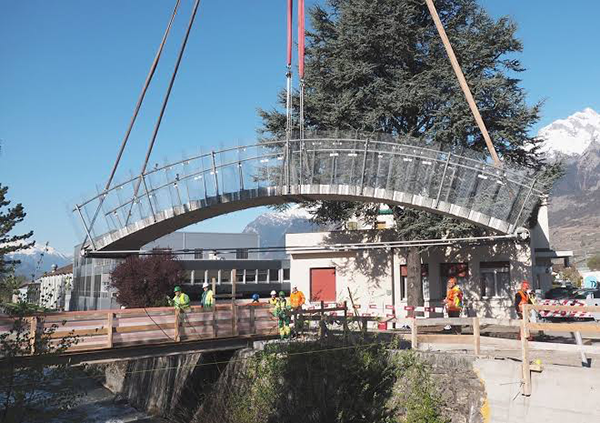
The reuse of concrete pieces for structural work was demonstrated in 2021 by the Re:Crete Footbridge that now spans the Morge River in Switzerland, an initiative led by researchers from the Swiss Federal Institute of Technology Lausanne (EPFL). This project established for the first time the feasibility of reusing concrete elements extracted from a cast-in-place structure in a new load-bearing application.
Designed and built by EPFL’s Structural Xploration Lab, the 10-metre segmented arched footbridge was created from 20-centimetre-thick concrete blocks saw-cut from the walls of a building under renovation. Twenty-five blocks were then drilled to allow the passage of post-tensioning cables and then assembled by placing the blocks on a timber centering so the post-tensioning ducts and cables could be threaded through the side holes.
Any exposed cut rebar was coated with anti-corrosion paint, with hydrophobic impregnation applied to the concrete faces and waterproofing strips covering the joints.
In terms of sustainability and carbon reduction, a detailed life cycle analysis showed the Re:Crete footbridge significantly lowered the environmental impact versus solutions using new reinforced concrete (-63 per cent) or steel (-75 per cent) and yet was only nine per cent more than building an entirely new bridge from wood.
The project was recognized with several awards, including Construction21 Network’s Infrastructure Users’ Choice Prize and the Sustainable Infrastructure Grand Prize of the national level of the Green Solutions Awards 2022-2023.
While reuse of construction material is gaining momentum, it is still struggling to scale up, particularly with concrete, although recycled concrete is already structured into supply chains for backfill and road sub-bases. Current practices are the primary obstacle to the development of reuse rather than recycling.
Ademe, a public agency under the joint authority of France’s Ministry for the Environment, Ministry for Energy and Ministry for Research, has brought together a group of 80 European stakeholders to study the feasibility of concrete reuse operations. It has supported six pilot projects, including a test site and research project in north central France, to study the reuse of load-bearing columns and beams.
According to the findings of the ReCrete project, deconstruction can cost up to twice as much as a traditional demolition, even if the later reuse of components proves to be more affordable than construction with new materials. However, insurers are concerned about structural integrity, resulting in several projects being abandoned when unable to secure suitable coverage.
Karine Niego, an innovation and ecological transition consultant at YesWeGreen, believes reusing concrete requires overcoming organizational and structural barriers, just as when the construction sector confronts any new ideas.
“Today, our processes follow a simple logic: demolish, treat waste, rebuild,” she says. “The entire chain is conceived this way. However, reuse requires moving beyond this.”
There have been less than 100 concrete reuse projects to date, mostly in Europe. This is a problem compounded by the absence of concrete component resellers, says Célia Küpfer, an architect and professor at McGill University’s Peter Guo-hua Fu School of Architecture. If this interdependence between donor and recipient sites could be addressed, she says dismantling could be carried out independently of the target project.
Further successful examples, investigations and academic studies of concrete reuse will hopefully bring increased acceptance in the near future.
John Bleasby is a freelance writer. Send comments and Climate and Construction column ideas to [email protected].