Tuesday, July 7 dawned in New York City with emergency crews responding to reports of major structural damage at 235 East 42nd Street in Midtown Manhattan.
The 37-storey former Pfizer headquarters, under conversion into apartments, began showing alarming signs of potential collapse. This triggered evacuations of construction workers, occupants of adjoining properties, street closures and significant disruption around Grand Central Terminal during the morning rush hour.
Upon inspection, a safety manager subsequently reported a steel beam on the 21st floor was compromised. Fire department officials confirmed two internal support columns were buckling and several upper floors were sagging.
Cliff Johnsen of Steamfitters Local 638 described the scene, saying the building’s north side was “crumbling” and that “I-beams are bending like cigarettes.”
By Tuesday evening, NYC Buildings Commissioner Ahmed Tigani declared the building stable and expressed confidence in the emergency plan, though he warned the surrounding area could remain tense for several days.
The episode has led to increased scrutiny of the emerging development of office-to-residential conversions.
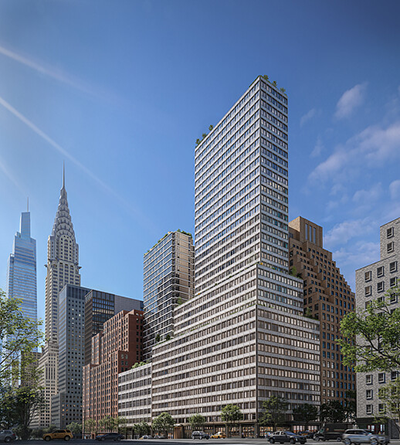
The Pfizer building conversion project, led by Metro Loft and David Werner Real Estate, began in 2024. It is said to be the largest and perhaps the most ambitious office-to-residential conversion in the United States, comprising 1,602 apartments, 400 of which are designated affordable, plus extensive amenities including shops and a rooftop pool.
It is far from a simple project. The conversion involves two office buildings from two earlier eras, one from the early 1900s and the other from the 1960s and includes the addition of roughly 30 storeys built atop the older structure.
Office-to-residential conversions offer great promise in terms of providing housing in urban centres while reducing the carbons from demolition and rebuilding. However, the event has sent a slight shudder through the property development industry.
Will the Pfizer incident put a permanent dent in future projects?
The positive news is that engineering experts and real estate analysts remain confident this was an isolated incident that should not undermine overall confidence in the broader conversion movement.
Ben Schafer, a structural engineering professor at Johns Hopkins University, explained to ABC News the incident did not reveal gaps in engineering knowledge.
“I don’t think it really brings into question our understanding of how to do something like this,” Schafer said.
He explained the engineering approaches involved, such as threading new load-bearing systems through older structures and carrying weight down to the foundation, are well understood.
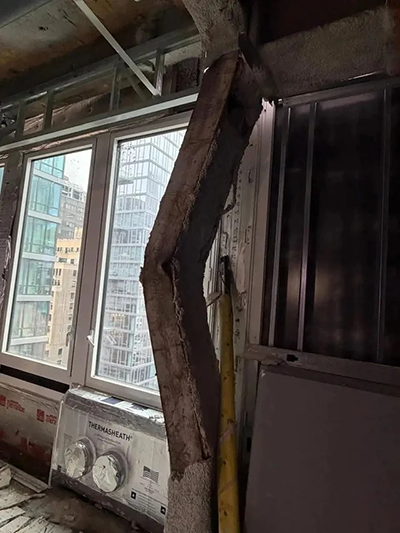
While the cause has not been officially determined, experts believe the failure likely stemmed from added loads during construction coupled with project-specific errors such as misunderstood design assumptions, design or construction errors, or overloading during construction, and not a fundamental flaw in adaptive reuse methodology.
The case for continuing conversions remains compelling for both environmental and financial reasons. Demolition is enormously wasteful, while new building construction accounts for roughly 40 per cent of global energy-related carbon emissions.
Schafer called teardowns “a disaster” from a sustainability standpoint.
Economically, demolishing and hauling away large buildings in dense cities like New York is prohibitively expensive. At the same time, many existing structures are well-suited for conversion.
At stake is the nature of urban housing policies. Cities across North America regard conversions as solutions to their housing shortages and key to revitalizing downtown districts.
Joshua Harris of Fordham University’s Real Estate Institute emphasized conversions are, “very, very complicated surgical procedures being done to very old buildings.”
Occasional setbacks, he argued, are “part of the reality of fixing the housing crisis.”
Office-to-residential conversions remain a safe and vital solution to the housing shortage.
Rather than halting the conversion movement, experts believe the incident will likely be seen as an incident stemming from the project’s individual complexity rather than a systemic problem, and will result in a “gut check,” that may prompt other projects to review their designs. Over time, this could strengthen, not weaken, the industry.
Even New York Mayor Zohran Mamdani suggested the type of conversion at the Pfizer building was not to blame.
“We are going to be conducting a full investigation because this is not a necessary consequence of an office-to-residential conversion.”
He continued by saying the incident wouldn’t change the city’s support for such projects, which recently received a boost in state funding.
“I do continue to consider the conversion of office space into residential space as part of our answer to the housing crisis,” he said. “I also consider that we have to do it safely and in a way that is fully accountable.”
At the same time, the Pfizer building conversion did bring to light issues that go beyond the question of conversions themselves.
New Yorker magazine noted the project “used almost no organized labour,” resulting in strong reactions from the Steamfitters, the only union workers on the site.
Questions have also been raised concerning the past safety record of Domani Inspection Services, the private “special inspection agency” that certified structural work at the site, including high-strength bolting and steel welding.
Also in question is how values of the 1,600 residential units would be impacted in the marketplace.
Trent Cotney, a partner at Florida-based law firm Adams & Reese, called the Pfizer project a “widow maker,” joining other experts who say a legal dogfight over responsibility is in the making.
“It’s definitely going to put a bunch of lawyers’ kids through college,” commented Dan Rosenberg, principal at Much Shelist in Chicago.
Even though the Pfizer project is considered an outlier due its scale and vertical expansion, the incident will impact future office-to-residential conversions in several specific ways, such as stricter regulatory scrutiny.
Possible longer-term outcomes also include tighter financing oversight in the form of structural and engineering audits prior to approval, higher insurance premiums and perhaps even a shift in conversion types to simpler designs than the Pfizer project.
John Bleasby is a freelance writer. Send comments and Climate and Construction column ideas to [email protected].