A branch of the Brooklyn Public Library under construction will be one of the first public mass timber buildings in New York.
Mass timber wasn’t originally on the library administration’s radar. The team had planned to renovate the existing Canarsie branchCanarsie Branch Library Reconstruction – New York City Department of Design and Construction (NYCDDC)StatusDesignValue$5MLocation1580 Rockaway Pkwy, New York NYSectorPublic – CityTypeLibrary · New Construction · DemolitionData as of July 29, 2026View Project Page →, but it became clear during preconstruction the flexible space and modern infrastructure the community needed would require something more.
A new build was determined to be the best solution, says Jonathan Fiato, senior director at Shawmut Design and Construction, the construction manager.
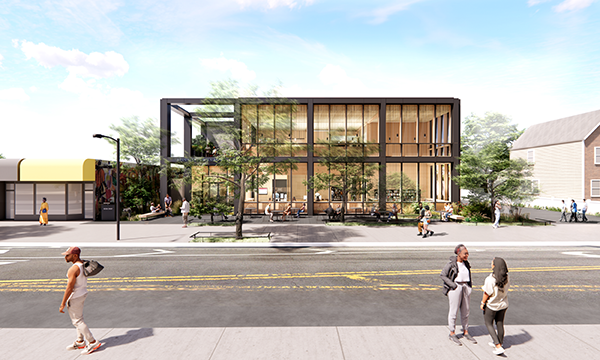
The two-floor, 11,000-square-foot building will double the library’s public space, providing separate areas for adults, teens, children, a meeting room for up to 50 people, a recording studio, maker space and an outdoor terrace.
A design by architectural firm Studio Joseph, the Cross-Laminated Timber (CLT) structure is incorporated as a visible architectural element, including integration within the building envelope’s curtainwall.
The building uses exposed CLT and glulam, which requires special sequencing, protection and co-ordination with other trades.
Shawmut is working with Mercer Mass Timber on supply and design‑assist so early-phase co-ordination has been critical.
Metropolitan Walters will be installing the timber.
Fiato says mass timber was selected largely because it provides sustainable benefits – an important factor to the Brooklyn Public Library. Other sustainable features will be a rooftop solar panel system and onsite stormwater management.
Shawmut is no stranger to mass timber. It has completed 11 mass timber buildings, co-ordinating thousands of prefabricated components, aligned fabrication timelines with site logistics and integrated mass timber systems seamlessly into complex builds.
But on the library project some of Shawmut’s trade partners and consultants were relatively new to the field and needed to do research and train employees to be in compliance with mass timber regulations which were embedded in the 2022 NYC Building Code.
Fiato says Shawmut is ensuring protection measures for the wood such as waterproofing and it has worked with the trades to preserve architectural vision.
Shawmut worked closely with members of Studio Joseph and Envoie Projects, the owner’s representative and project manager, passing along best practices from three of the contractor’s mass timber projects in the northeast.
Fiato says one of the challenges at the library is the integration of the thermally-sealed glass and curtainwall to meet the tight tolerances specified for the CLT.
“It required very careful planning, co-ordinating and detailing, specifically of the structural connections and beam sizes.”
He says a 16-by-13-foot façade mockup was built offsite to validate the façade. The entire building was modelled in 3D prior to fabrication to co-ordinate all trades.
The contractor worked with the design and acoustical consulting teams on the specification of the acoustical system for the library and its recording studio. TECTUM wood fiber panels and a terrazzo-style rubber floor are key elements to noise reduction.
Fiato says community engagement was essential in shaping the final design. Input came from hundreds of Canarsie residents, library patrons, community organizations, elected representatives, service providers and other key stakeholders.
“We’re viewing this as a test case as the city explores this technology and material. The design and construction industry sees the successful completion of this project as well as how it’s received by the community as an opportunity to underscore mass timber as a viable, preferred construction material and technique in the city,” says Fiato.
The existing 65-year-old library has been demolished and foundation work is underway on the new building. Completion is slated for 2027.
Funding is largely through municipal and state agencies.