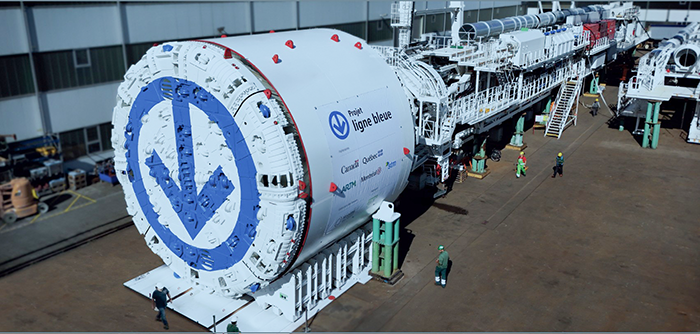
Lisette is the newest addition to Montreal’s construction scene, the biggest-ever tunnel borer used in the province and, in this case, by the city’s transit system, the Société de Transport de Montréal (STM).
Beginning in May it has been digging through hard rock as much as 40 metres below the city’s east end neighbourhoods as it bores a 4.6-kilometre tunnel eastward for the city’s first metro (subway) extension since 2007.
This will link the metro’s Blue Line St. Michel terminusConstruction of the of the Montreal Subway Blue Line Extension TunnelStatusAwardValue$1.28BLocationMontreal QC H3B 0A2SectorPublic – CityTypeTransportation TerminalsData as of July 29, 2026View Project Page → to a new terminus in Anjou and adds five stations, for a total of six kilometres.
Lisette is fondly named for the metro’s first female train operator and was built by Germany’s Herrenknecht.
Electrically powered by a continually rolled out 25 kV line, it weighs more than 2,000 tonnes and is 135 metres in length.
A giant white cylindrical machine works most of a 24-hour day. Its face a revolving cutterhead is 9.7 metres in diameter, boring out an average of 10 to 15 linear metres per day and is operated by a relatively small crew.
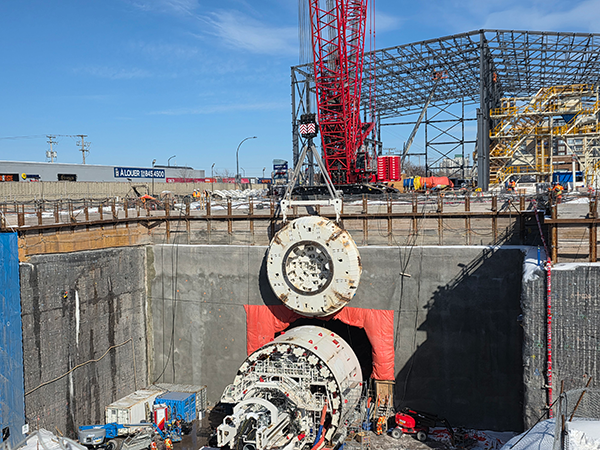
Sarah Bédard Giulione, the Blue Line extension project director, said the machine was custom designed for the Montreal project including the tunnel dimensions and soil conditions.
“It’s a very hard rock so the machine needed to be built around this rock configuration,” she said. As well, the excavator, known generically as a Tunnel Boring Machine (TBM), is “open” in profile because it will not be encountering any subsurface water.
The TBM was installed at the first of the five stations, Vertières.
The part of the tunnel linking the existing St. Michel terminus and Vertières was alternately gouged out by conventional roadheaders (boom mounted cutters).
The reason was that the TBM once installed couldn’t be reversed. And there was ample space there on the new construction site to assemble, which took seven months, after the TBM was shipped from overseas.
The tunnel borer method was chosen because excavation would be underneath densely populated neighbourhoods and therefore would be less disruptive and environmentally sensitive.
It’s also “actually quite fast,” Bédard Giulione said.
A roadheader would have excavated only three or four metres a day. The 50 cutting discs (and tools) on the face need to be changed frequently as they wear down from the limestone.
The TBM is like a factory in itself, with its cylindrical head followed by lengthy open ironwork. The cutterhead cuts the rock and sends it on a screw conveyor through the machine and on to conveyor belts to be removed and trucked to the nearby Saint-Michel Quarry.
Meanwhile as it progresses every two metres it stops and installs so-called “voussoirs” or seven precast concrete panels to form a tunnel ring lining, stabilizing the walls to allow work to continue.
The machine uses these to push forward using seven hydraulic cylinders. The onboard crew tracks the correct path via sensors and GPS. About eight rings a day are installed. The process is mostly mechanical with some human labour. The operating team has about 20 people.
“We have some handywork but it’s mostly mechanical,” Bédard Giulione said. “The machine works by itself, but we have people to make sure everything’s going fine.”
Altogether 300,000 square metres of rock will be removed and 14,000 voussoirs installed.
As the tunnel is bored vertical excavation has almost been completed at the five stations that will meet the horizontal tube which varies in depth from 17 to 40 metres depending on the rock hardness and factors like station entrance and exit slopes to slow approaching trains (uphill) and accelerate departing ones (downhill), saving wear and tear on brakes and reducing energy.
But those stations’ tunnel segments, including the future passenger platforms, are separately being hollowed out to meet the TBM.
There have been no challenges to date though, Bédard Giulione says, “though we’re still at the beginning.”
She said a thorough subterranean investigation had been carried out “and we were pretty confident about what rock we would encounter, and the machine was custom made for this kind of rock.”
Boring will be finished by early 2028, taking just over 18 months. The subway extension will open to the public in 2031.
The contractor is MBH (Mobilité Bleu Horizon) a joint venture consortium of Pomerleau and EBC – two of Quebec’s most well-known companies – and France-based Spie batignolles, which brings the TBM expertise.