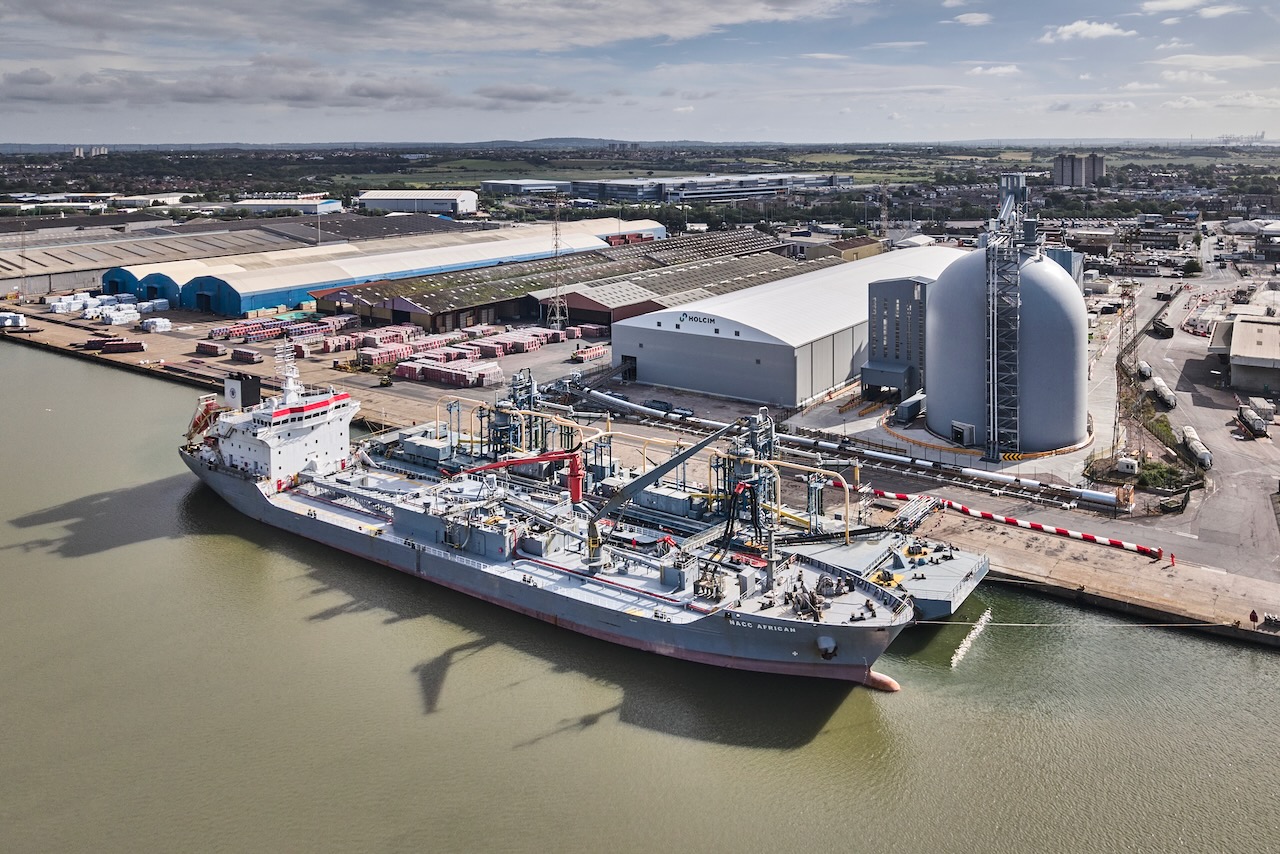
The facility is designed, Holcim says, to reshape cement supply into one of the UK’s highest‑demand regions. As well as the busy market in London and the South East, the site is close to works to build the Lower Thames Crossing.
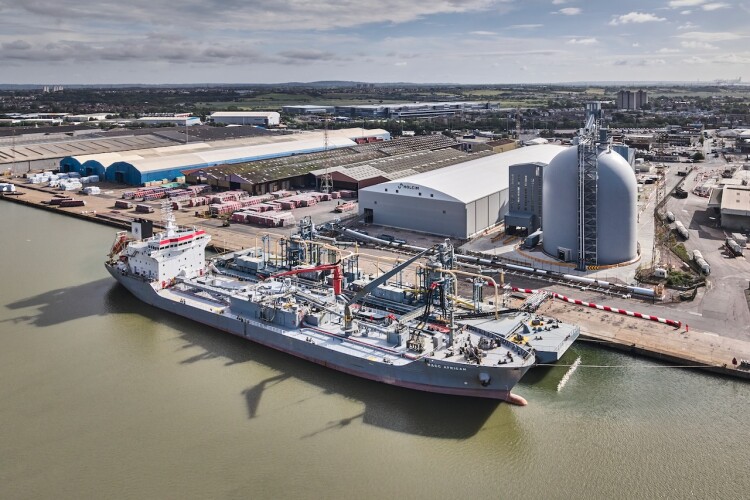
Located at the Port of Tilbury, the new cement works combines deep‑water marine access with large‑scale storage, automated logistics and a modular grinding and blending system that will come online later in 2026. This places high‑volume processing capacity directly at the point of demand, reducing reliance on long‑distance inland transport and improving supply resilience.
Tim Fry, project manager at Holcim UK, said: “Initiating import and distribution of cementitious materials is a major step forward for Tilbury Cement Works and for Holcim’s ability to serve customers across the South East. This phase demonstrates the strength of the systems we’ve built, from marine logistics to storage and dispatch, and reflects the hard work of everyone involved in bringing this facility to life. As construction concludes in 2026 and we move into full operations, Tilbury will provide the flexibility, reliability and capacity to support our customers with a range of conventional, low carbon and circular cementitious materials.”
Tilbury is geared to support continuous operations and includes a new ship‑to‑shore conveyor system, enclosed belt conveyors and the UK’s first 30,000‑tonne cement dome silo. Material is transferred directly from vessel to storage, before being processed and dispatched through six loading heads and five weighbridges.
The facility is strategically located in a deep‑water berth to allow the site to receive large bulk vessels as part of Holcim’s global logistics network, improving economies of scale and reducing freight‑related emissions. The facility will also be served by the NACC Sustament – expected to enter service in 2027 – which will be the world’s largest and most sustainable cement carrier, operating on green methanol.
While cement import and distribution signals Tilbury Cement Works going live, the next major milestone will be the completion and commissioning of the site’s vertical roller mill (VRM) later in 2026. The VRM will grind granulated blast furnace slag (GBFS) and recycled concrete fines (RCF), enabling the production of ground granulated blast furnace slag GGBFS and blended cements.
Full product lines, including Holcim’s ECOPlanet low‑carbon cement and ECOPlanet with ECOCycle circular materials, will come online in early 2027. The terminal has been engineered with forward flexibility, allowing it to process future materials, such as calcined clay, as the UK transitions to lower‑carbon construction.
Mohamed Alami, managing director of Holcim UK’s Cement Division, said: “Tilbury is a transformational investment for Holcim UK. It will ultimately support our ECOPlanet low-carbon cement and ECOPlanet with ECOCycle and accelerate the shift to low‑carbon and circular construction. This reflects our commitment to making sustainable construction a reality, and building a resilient, future‑ready supply chain for our customers.”
The construction of Tilbury Cement Works has itself followed circular principles, with 25,000m³ of concrete crushed and reused on site, 10,000 tonnes of reclaimed asphalt incorporated into Holcim’s asphalt products, and 20,000 tonnes of excavated material processed through the company’s recycling hubs.
Got a story? Email [email protected]