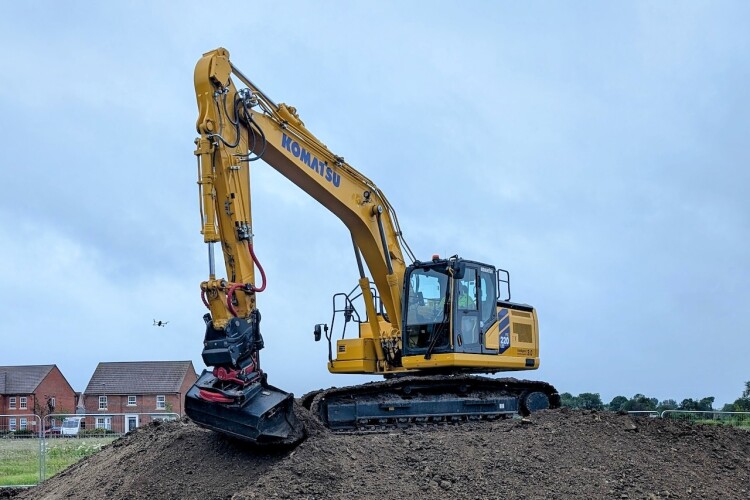
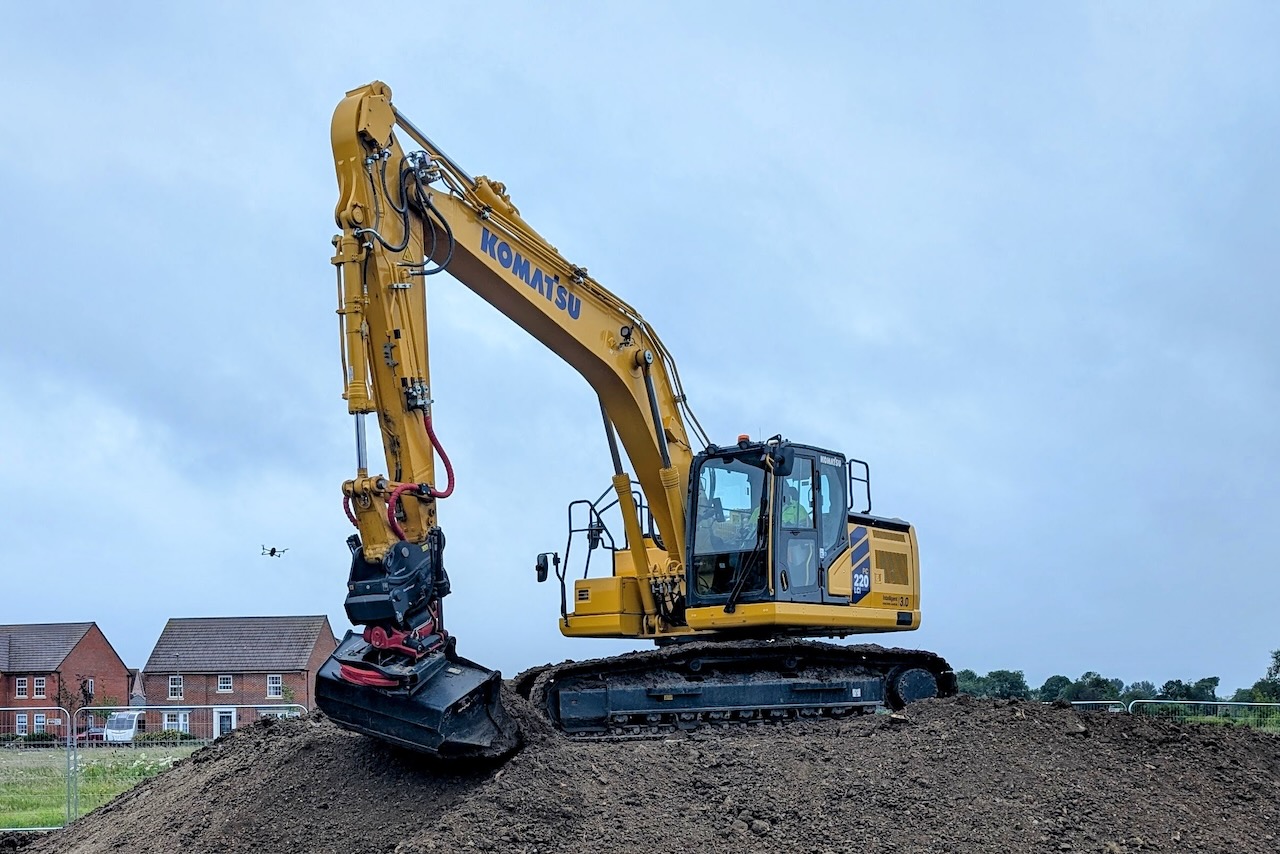
Tito Baldan, senior general manager for distribution, Europe, opened the launch event, and explained the decision to build the new excavator in Newcastle, where the company has recently employed an extra 200 staff to build the new machine.
“The philosophy of Komatsu is to have worldwide engineering,” Baldan said. “We want to reduce our impact on the environment, so producing where we sell will reduce CO2 emissions—we want to have 50% less emissions by 2030 versus 2010, and to go to zero emissions by 2050.
“But very importantly, design and development locally allow us to adapt to local needs.”
One example of how the machine is being localised is through its hazard detection. In Japan, where job sites tend to have fewer personnel working around excavators, this is done using radar. On busier European sites radar detection would create too many false positives, and Komatsu is developing a camera-based system which will feature a slow-and-stop mechanism, rather than a simple alarm or alert, where personnel are detected—this will be available on the PC220 in coming months.
Another peculiarity of the European market, particularly in the north of the region, is the use of tilt rotators. As he walked visitors around the excavator, Vince Porteous, product manager, explained how Komatsu has worked with suppliers including Engcon and Rototilt to develop a simple plug-in system for the tools—the company is currently working with Steelwrist to add support for their attachments. As well as easing set up of the machine when using these tools, the control system can handle their complex movements, reducing the number of simultaneous movements to be made needed by the operator from six to two.
In a live demonstration, operators showed how simply the machine can be used with a tilt rotator to deliver a smooth grade. Similarly, in trenching, the movements of the excavator can be set to follow a path, with the operator able to move backwards and forwards along the trench without steering. In loading operations, an operator can mark a truck or dumper‘s location, and then fill it automatically.
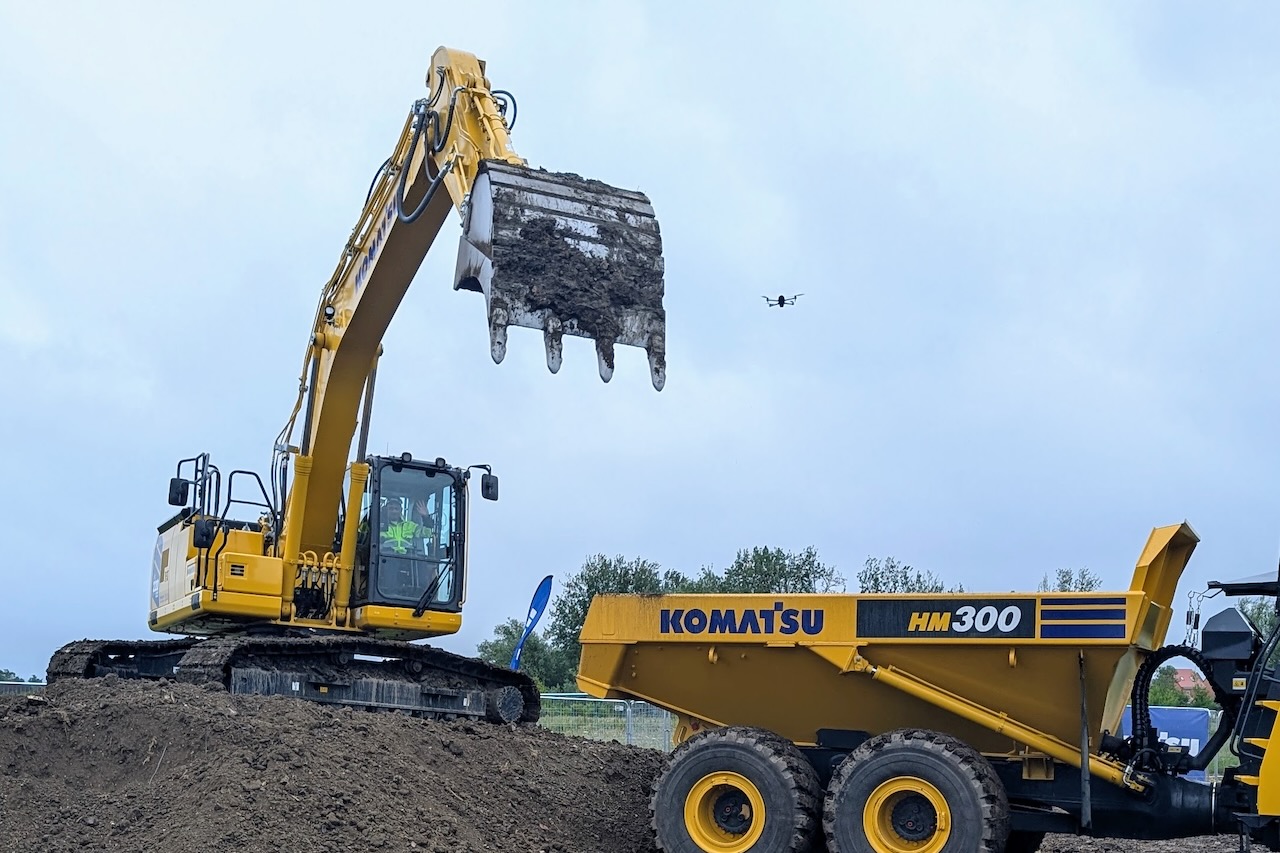
From the engine to the hydraulics, many of the excavator‘s components are designed and manufactured by Komatsu. Porteous pointed out one key difference between this machine and its predecessors. Earlier machines had a single hydraulic spool, controlling the movement of fluid in and out of the valve. On the PC220-12, separate inlet and outlet valves are used.
This, product manager Paul Dickinson explained, means that differing amounts of hydraulic fluid can be let in and out simultaneously, offering more individualised control over working speeds.
Operator access to the machine is controlled using an electric key or code. Each operator can decide on how the controls are set up to suit their working methods—Porteous pointed out that older operators, experienced on hydraulically-controlled machines, will be used to less responsive controls; younger operators, whose first experience of a human machine interface may well come from using a gaming console, will expect more sensitive controls. On the PC220-12 LC machines, up to 33 different settings can be changes; on the PC220-12 LCi, with Komatsu‘s upgraded Intelligent Machine Control or IMC 3.0, up to 49 different settings can be programmed.
One of the big changes for operators in the physical design of the machine is in the cab. “Our cab hasn’t changed a lot in the last previous couple of generations of machine,” Dickinson acknowledged, “So when we started the research for this machine, we started with the operators.”
Looking forward, the monitor panel has been moved from the A-pillar, to the right hand console. That both gives the operator a clearer view, and removes obstructions to the operator’s foot space. This contributes to a 50% improvement in visibility in the front. At the operator’s rear, previous machines featured a large mound on the hood, to accommodate after-treatment. On the PC220, the top of the machine has been raised slightly and the engine dropped, giving more visibility out of the back.
The operator’s life is made easier through the new 3.0 version of Intelligent Machine Control, IMC, available on the PC220-LCi. LC versions of the PC-220 can be adapted to use IMC 3.0, allowing customers to upgrade their machine as they take on more demanding jobs.
One of the simplest features of the system is the ability to transfer files on and off the machine. This can allow operators to report on each day’s work, and as built conditions, collecting data at a rate of 25 point per square metre per second as they work; conversely, design files can be updated from the office, giving the operator a clear view of any changes to the works planned.
The same system, Smart Construction Remote, can be used to offer support to the operator, without a technician visiting the site.
Areas of the work site can be set as out of bounds, by marking two points. The line between these is then extended infinitely, preventing work in this area.
Where the PC-220 is being used for loading trucks, the quantity of material loaded can be tracked to prevent overloading. This data can then be sent back to office using a system called Smart Construction Fleet Light, allowing for accurate reporting of materials moved and invoicing of clients.
Both of these features—Smart Construction Remote and Smart Construction Fleet Light—are offered without a subscription, for the life of the machine.
More powerful tracking of material movements can be done using a system known as Smart Construction Simulation. On a cut and fill job, where material is being moved around site, this can be used to optimise soil distribution. A fleet owner can use this to work out where to cut material from first, and where to fill.
Vingerhoets explained that the job site can be split into different zones, and the AI-powered system will determine the optimal way of transporting that material. This can include experimenting with different configurations of excavator and bulldozer size or number of dumpers used, to find an optimal solution and predict an end date for the work.
Got a story? Email [email protected]